
The Best Beaches and Coves in Fethiye (2026)
From Butterfly Valley to the Yassıca Islands and from Ölüdeniz to Kabak Beach, the 21 best beaches, coves and islands in Fethiye: how to get there, whether entry is free and who each one suits.
Also available in: English, Türkçe


The best beaches and coves in Fethiye include Butterfly Valley, St Nicholas (Gemiler) Island, Şövalye Island, Kızılada and the Yassıca Islands, which you can only reach by boat, and Ölüdeniz’s Blue Lagoon, Kabak Beach, Kıdrak, Katrancı Bay and Çalış Beach, which you can reach by car. This guide covers 21 beaches, coves and islands in two groups. We start with the ones you can only reach by boat, then move on to the beaches you can drive to. More than 500 boats and yachts based in the Fethiye area are listed on viravira.co, and we follow their routes closely every season. For each spot we checked where it is, how to get there and whether you pay to get in against official sources and our team’s own experience on the water.
Fethiye Beaches and Coves at a Glance
The table lists the boat-only coves and islands first, followed by the beaches you can reach by car.
| Beach / cove | Location | How to get there | Entry | Best for |
|---|---|---|---|---|
| Coves and islands you reach by boat | ||||
| Butterfly Valley | 30-45 min by boat from Belcekız | Boat only | Boat fare (check valley entry on the day) | Nature lovers, photographers |
| Cold Water Bay and the Blue Cave | Ölüdeniz coast | Boat only | Included in boat trips | Boat trip guests |
| Aquarium Bay | Ölüdeniz coast | Boat only | Included in boat trips | Snorkelling |
| St Nicholas (Gemiler) Island | Off Kayaköy | Boat only | Paid (archaeological site) | History lovers |
| Karacaören Bay | Coastal route from Fethiye to Gemiler | Boat only | Anchorage, no facilities | Overnighting on a boat |
| Şövalye Island | Opposite Fethiye town | Water taxi (about 10 min from Çalış) | Small free beach, others belong to hotels | A quiet island day |
| Turunç Pınarı Bay | 15-20 min by boat from the harbour | Boat only | Usually free, restaurant spend expected | Fresh-water swims, short trips |
| Samanlık Bays | Fethiye peninsula, near the harbour | Mostly by boat, some by car | Check locally | First or last swim stop of a boat trip |
| Kızılada (Red Island) | Mouth of the gulf, about 6 km out | Boat only | 12 Islands trip stop | Lighthouse views |
| Tersane Island | Western side of the gulf | Boat only | Trip stop, seasonal restaurant | Lunch stops, sheltered anchoring |
| Domuz Island | West of Tersane | Boat only | Swim stop offshore | Boat trip guests |
| Yassıca Islands | Inside Göcek Bay | Boat only | 12 Islands trip stop | Shallow turquoise water, families |
| Beaches and coves you can reach by car | ||||
| Ölüdeniz (Belcekız and the Blue Lagoon) | 12-14 km | Car, shared minibus | Belcekız generally free, Blue Lagoon (Kumburnu) paid | Everyone, watching paragliders |
| Kıdrak Beach | Near Ölüdeniz | Car | Paid (nature park) | A quieter day, families |
| Çalış Beach | 3-4 km | Shared minibus, car, boat | Free public beach | Staying in town, sunsets |
| Katrancı Bay | About 15 km | Car, shared minibus (Göcek road) | Paid (nature park) | Camping, campervans |
| Günlüklü Bay | 15-17 km | Car, shared minibus (Göcek road) | Paid (nature park) | Families, forest shade |
| Boncuklu Bays | End of Karagözler | Car, shared minibus | Sunbeds paid | A calm cove close to town |
| Kuleli Bay | Fethiye peninsula, Keçiler | Car (Karagözler road) | Paid (beach operator) | Families, separate beach sections |
| Kabak Beach | Via Faralya | Footpath, local shuttle, boat | Check before you go | Campers, hikers |
| Gemiler Bay (Gemile Cove) | About 6 km from Kayaköy | Car, boat | Check before you go | Crossing to St Nicholas Island |
The 21 best beaches, coves and islands in Fethiye. Sources: official websites and local press (November 2026). Fees can change.
About nature park fees: The Ölüdeniz-Kıdrak, Katrancı Bay and Küçük Kargı nature parks share the same category in the Turkish Ministry of Agriculture and Forestry’s 2026 tariff. Children under 7 and visitors over 65 entering on foot don’t pay, and students get half price with ID. The same rules allow each site to charge visitors who are not Turkish citizens between five and ten times the standard personal fee, so foreign visitors may pay more than the base rates quoted in this guide.
Fethiye Coves and Islands Accessible by Boat
South of Ölüdeniz and around St Nicholas Island, steep slopes drop straight into the sea and a string of coves has no road access at all. Most of them are stops on the Ölüdeniz boat trip. The Ölüdeniz lagoon is protected, so boats don’t enter it, and day trips leave from Belcekız Beach.
Butterfly Valley

Butterfly Valley (Kelebekler Vadisi) is a valley south of Ölüdeniz that opens onto the sea between cliffs about 350 metres high. Boats from Belcekız get there in 30-45 minutes. The valley is named after the more than 80 butterfly species that live here. The best known is the Jersey tiger moth (Euplagia quadripunctaria), locally known as kaplan kelebeği, which is most visible in mid-July, so plan your visit around then if you want to see it.
The natural sections of Butterfly Valley were designated a first-degree natural protected area on 8 February 1995. In 2019, certain parts of the valley were designated as a “Strictly Protected Sensitive Area” by a Presidential Decision. However, the part of that decision concerning certain parcels of land was annulled by a Council of State ruling that became final in 2022. In 2023, a specific part of the valley was designated as a “Qualified Natural Conservation Area”. As a result, different parts of Butterfly Valley are subject to different protection designations, depending on the applicable boundaries and decisions currently in force.
Although some sources claim that Butterfly Valley is a UNESCO World Heritage Site, this is incorrect. Butterfly Valley is not included on the UNESCO World Heritage List.
Safety note: The steep path down to the valley from Faralya is considered dangerous, and in 2017 the Fethiye District Governor’s office asked for it to be closed. We recommend going by boat from Belcekız.
Open Butterfly Valley in Google Maps
Cold Water Bay and the Blue Cave
Cold Water Bay (Soğuksu Koyu) and the Blue Cave (Mavi Mağara) are the two best-known stops on the boat trips from Ölüdeniz, and you can only reach either from the sea. At Cold Water Bay, fresh water from the mountains seeps into the sea between the rocks, so don’t be surprised when the water turns noticeably colder in patches as you swim.
The Blue Cave is a sea cave carved into the rock by the waves over time. Boats stop briefly in front of it. Bear in mind that more than one place around Fethiye goes by the name “Blue Cave”.
Open the Blue Cave in Google Maps
Aquarium Bay
Aquarium Bay (Akvaryum Koyu) is a small cove that Ölüdeniz boat trips usually visit after Butterfly Valley. Sheltered from the wind between the rocks, it takes its name from water so clear it looks like an aquarium. There’s no road to it, so the only way in is by boat.
There’s another Aquarium Bay on the Göcek side, and the two are often confused. If a trip itinerary lists Aquarium Bay, check whether the boat leaves from Ölüdeniz or from Göcek.
Tip: You’ll see the clear water best with a snorkel. Not every boat carries masks and snorkels, so we recommend bringing your own.
St Nicholas Island (Gemiler Island)

St Nicholas Island, known locally as Gemiler Adası, is a historic island off Kayaköy that you can only visit by boat. According to Türkiye’s Ministry of Culture and Tourism, surveys have identified 11 churches across Gemiler Island and the surrounding area, including four on Gemiler Island itself. The island also contains chapels, houses, tombs and cisterns dating back to the Byzantine period.
The island is a Ministry archaeological site, so there’s an entry fee. The Ministry’s museum website lists it at €3 for non-Turkish visitors aged 8 and over and 200 TL for adult Turkish citizens. Some of the ruins along the shore now sit at sea level or partly underwater, and boat trips usually stop for a swim around the island.
Tip: The ruins climb up the hill and there’s very little shade on the way. Take a hat and water with you, and we recommend exploring during the cooler hours of the day.
Open St Nicholas Island in Google Maps
Karacaören Bay
Karacaören is a bay on the boat route that runs south from Fethiye towards St Nicholas Island and Ölüdeniz. It takes its name from the islet of about 200 metres just offshore, which is scattered with Byzantine ruins. Gulets and yachts use Karacaören as a swim stop or an overnight anchorage.
Skipper’s note: Boats here drop anchor on sand in 10-15 metres of water and take a stern line ashore. Watch out for rocks and shallow reef areas on the approach.
If you’d rather explore the Ölüdeniz coast on your own route instead of on a crowded tour boat, you can charter a private boat. That way you can reach Butterfly Valley before the tour boats arrive and spend the night in a quiet cove like Karacaören. You’ll find hourly, daily and weekly charters from Fethiye on our Fethiye yacht charter page.
The other boat-only spots on this list are in the Gulf of Fethiye. Turkey’s Ministry of Environment lists the gulf’s islands as the “Twelve Islands” (Oniki Adalar) in the records of the Fethiye-Göcek Special Environmental Protection Area, which was declared in 1988. That list includes Şövalye, Tersane, Kızılada, Katrancı, the Delikli Islands, Kızlan, Hacı Halil, Yassıca and Domuz.
Şövalye Island
Şövalye Island (Knights’ Island) sits in the gulf directly opposite Fethiye town and is the only inhabited island in Fethiye. According to a 2018 report by Turkey’s Anadolu Agency, the island covers about 23 hectares and has 70 buildings, 4 places to stay and 1 restaurant. There are no cars and no roads.
The island takes its name from the Knights of Rhodes, who were in the region in the 15th century. Most of its church, chapel and cistern ruins date from the Byzantine period. Şövalye Island was declared a third-degree archaeological site in 1982 and a third-degree natural site in 1994, and it lies within the Fethiye-Göcek Special Environmental Protection Area.
Water taxis from the jetty at the end of Çalış Beach take about 10 minutes to cross. The hotels on the island pick up their own guests by boat. There’s a small free public beach, but nothing is sold there. The other beaches belong to the hotels and restaurants, where you can buy whatever you need.
Open Şövalye Island in Google Maps
Turunç Pınarı Bay

Turunç Pınarı Bay lies across from Fethiye harbour, behind the Oyuktepe peninsula, and takes 15-20 minutes to reach by boat from the harbour. What sets it apart are the cold fresh-water springs that flow into the sea between the rocks. If you’re looking for a fresh-water swim near Fethiye, this is one of the first places to try.
The bay has restaurants with their own jetties. There’s usually no entry fee, but if you tie up at a jetty you’re expected to eat or drink at the restaurant. Turunç Pınarı is also a regular stop for guests who charter boats through viravira.co.
Open Turunç Pınarı Bay in Google Maps
Samanlık Bays
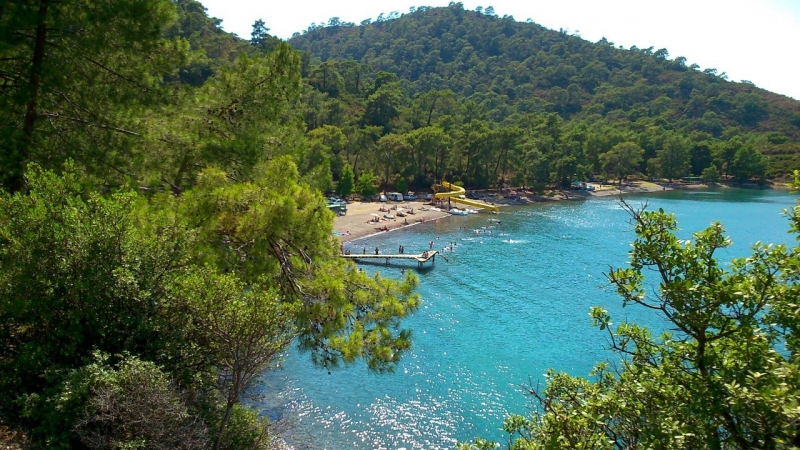
The Samanlık Bays are two neighbouring coves on the Fethiye peninsula, a short sail from the harbour. Most people arrive by boat, although you can also drive in on the paved road via Karagözler. A low headland separates Büyük (Big) Samanlık from Küçük (Little) Samanlık, and the pine forest on the slopes runs almost down to the water. They’re sheltered from the wind, so the sea is usually calm and clear, and skippers often anchor here when it’s windy.
Being so close to Fethiye, the Samanlık Bays are often the first or last swim stop on boat trips in the gulf. Küçük Samanlık looks out towards Fethiye and Şövalye Island. The seabed is a mix of pebbles and sand, so we recommend water shoes when you get in from the boat, and watch out for sea urchins.
Open the Samanlık Bays in Google Maps
Kızılada (Red Island)
Kızılada, or Red Island, sits at the mouth of the Gulf of Fethiye, about 6 km off the town. A lighthouse that still works stands on its southern tip, and its soil and rocks have a reddish colour.
Kızılada is often the last stop on the 12 Islands boat trips from Fethiye harbour. Because it sits at the end of the gulf facing the open sea, it’s more exposed to the wind than the inner coves. If you’re going on your own boat, we recommend visiting earlier in the day, before the afternoon wind picks up.
Tersane Island

Tersane Island lies on the western side of the Gulf of Fethiye, separated from Domuz Island by a narrow channel. Its name means “shipyard” in Turkish, and it’s thought to come from the island’s use as a place to build and repair ships in the Ottoman period. The stone ruins of an old settlement still stand on the island.
The bay on the island’s north-west side is a well-sheltered anchorage. It has a seasonal restaurant with a quay, and the 12 Islands trips often stop at Tersane for lunch.
Open Tersane Island in Google Maps
Domuz Island

Domuz Island lies west of Tersane Island, about 100 metres off the Kapıdağ peninsula. The 12 Islands trips and routes out of Göcek pass right by it, and tour boats usually stop offshore for a swim. It gets very busy in high season.
Yassıca Islands

The Yassıca Islands are a small group of islets inside Göcek Bay, south-west of Göcek. Between the islets the water gets as shallow as waist height in places and turns turquoise over the sand. That’s why the 12 Islands trips often make their longest stop here.
A decision published in Turkey’s Official Gazette on 10 December 2022 declared the Yassıca Islands and certain surrounding areas a “strictly protected sensitive area”. You can reach these Göcek-side islands by boat from either Fethiye or Göcek. We cover Göcek’s other coves in the Göcek section below.
Tip: Boat traffic at Yassıca peaks around midday. For a relaxed swim in the shallows, we recommend stopping in the morning or late afternoon.
Open the Yassıca Islands in Google Maps
To see the gulf’s islands in a single day, you can join a 12 Islands boat trip or charter a private boat and set your own route. If you’d like to spend a few days on board and stay overnight among the islands, take a look at our Fethiye gulet charter and Fethiye blue cruise options.
Fethiye Beaches You Can Reach by Car
You can get to the beaches in this section by car, by shared minibus (dolmuş) or by taxi. Some of them are nature parks with an entry fee.
Ölüdeniz: Belcekız Beach and the Blue Lagoon

Ölüdeniz (Oludeniz) is Fethiye’s best-known beach, about 12 km from the town centre and around 30 minutes by car. It’s really two separate areas. Belcekız (Belceğiz) Beach faces the open sea, while Kumburnu, with its famous sand spit, wraps around the lagoon that English-speaking visitors call the Blue Lagoon. Kumburnu is inside the Ölüdeniz-Kıdrak Nature Park, so you pay to get in. The Ministry of Agriculture and Forestry’s 2026 tariff sets the park’s base fee at 85 TL per person and 255 TL per car. Foreign visitors may be charged more under the tariff rules, so check the current price before you go. On the Belcekız side, entry is generally free and you pay for sunbeds and umbrellas.
The lagoon is inside the Fethiye-Göcek Special Environmental Protection Area, and boats aren’t allowed into it. Anyone arriving by boat anchors outside. Belcekız Public Beach and Kumburnu Public Beach both received Blue Flag status in 2025. Babadağ, the mountain rising right behind the beach, is about 2,000 metres high. Paragliders take off from it and land on Belcekız after a flight of 20-30 minutes.
Tip: Head to Kumburnu if you want the calm, shallow water of the lagoon, and to Belcekız if you want open-sea waves and a view of the paragliders landing. The Kumburnu car park fills up early in summer, so going in the morning will save you time.
Kıdrak Beach

Kıdrak Beach (Kidrak) is a bay surrounded by pine forest a few kilometres from Ölüdeniz. It’s part of the Ölüdeniz-Kıdrak Nature Park, so there’s an entry fee. It’s known for being less crowded than Ölüdeniz.
The nature park’s facilities include a snack bar, sunbeds and umbrellas. It’s a good alternative if you want to visit the Ölüdeniz area but spend the day away from the crowds.
Open Kıdrak Beach in Google Maps
Çalış Beach
Çalış Beach (Calis) is a long public beach about 3-4 km from Fethiye town centre, and it’s free to use. You can get there by shared minibus (dolmuş), by car or by boat from the harbour. The Ministry of Environment leases the public beach to Fethiye Municipality, which runs it free of charge.
Çalış is also one of the nesting beaches of the loggerhead sea turtle (Caretta caretta). In summer, keep clear of the marked nest areas on the sand. The sunset behind the islands in the gulf is one of the most photographed sights on the beach.
Tip: The shared minibus (dolmuş) from Fethiye town centre gets you to Çalış in about 10 minutes. Go in the late afternoon and watch the sunset from one of the cafés along the seafront.
Open Çalış Beach in Google Maps
Katrancı Bay

Katrancı Bay (Katranci) is a nature park on the Fethiye-Göcek road, about 15 km from the town centre. It was declared a nature park in 2011 and has an entry fee. Pine and eucalyptus trees grow almost to the water’s edge, so it’s easy to find shade even in the hottest part of a summer day.
Katrancı has two separate coves. Day visitors swim in one, and the other is set aside for people staying in tents and campervans. There’s a restaurant, a shop and showers.
Tip: If you want to camp in a tent or campervan in Fethiye, Katrancı is the first place to look. Shared minibus (dolmuş) heading towards Göcek pass right by the entrance.
Open Katrancı Bay in Google Maps
Günlüklü Bay
Günlüklü Bay is 15-17 km from Fethiye on the D400 highway, a little past Katrancı. It lies within the Küçük Kargı Nature Park and has an entry fee. The bay is surrounded by sweetgum trees (sığla), which are native to this part of Turkey.
The beach is fine sand mixed with small pebbles, and it has a café, showers, toilets and a car park. Families with children often choose it for the shade and the calm water.
Open Günlüklü Bay in Google Maps
Boncuklu Bays

The Boncuklu Bays are two small coves at the tip of the Fethiye peninsula, beyond Karagözler. They’re close to the last stop of the Taşyaka-Karagözler shared minibus, so you can get there without a car.
Büyük (Big) Boncuklu has a beach bar with paid sunbeds and cabanas. Few coves this close to town stay this quiet, so weekday mornings are especially pleasant. Weekends get busier.
Open Büyük Boncuklu in Google Maps
Open Küçük Boncuklu in Google Maps
Kuleli Bay

Kuleli Bay is a small cove in the Keçiler neighbourhood on the Fethiye peninsula. You reach it by car by following the Karagözler road west from the centre. A private beach operator runs the cove and charges for entry. What makes it different is that the beach is split into three sections, one for families, one for men and one for women.
The shore is mostly sand and the water deepens gradually, which makes it comfortable for children and less confident swimmers. The rocks in the shallows can be slippery with algae, so water shoes help. Sunbeds, shade, changing cabins and a snack bar are all inside the beach area.
Open Kuleli Bay in Google Maps
Kabak Beach

Kabak Beach (Kabak Bay) is tucked between steep slopes south of Faralya. People walk down the footpath from Kabak village, take a shuttle run by local businesses or come by boat. The Lycian Way passes through the area, which is known for its yoga retreats, bungalows and back-to-nature camping.
Cennet Bay, often mentioned together with Kabak and Butterfly Valley along the Lycian Way, is in the same area. Because it’s hard to reach, Kabak has kept much of its natural character. The pine-covered slopes and local plant life make it one of the most photographed coves in Fethiye.
Tip: The path down to the beach is steep and rocky. Wear trainers with good grip instead of flip-flops and take plenty of water. Plan your return time knowing it’s an uphill walk back.
Open Kabak Beach in Google Maps
Gemiler Bay (Gemile Cove)

Gemiler Bay, also called Gemile Cove, is about 6 km from Kayaköy and faces St Nicholas (Gemiler) Island directly. You can drive there from Kayaköy, the village known for its abandoned stone houses. St Nicholas Island, which we covered above, can only be visited by boat, and people often mix the two up.
Surrounded by pine and olive trees, the bay is also a regular stop on the boat trips from Ölüdeniz. It lies within the Fethiye-Göcek Special Environmental Protection Area, and local boats can take you across to the island.
Open Gemiler Bay in Google Maps
Göcek’s Coves and Islands

Göcek, about 28 km from Fethiye, is one of the best areas for a boating holiday thanks to its islands and coves. We covered the Yassıca, Tersane and Domuz islands on the Göcek side above. Göcek has been a neighbourhood of Fethiye since 2013 and has six marinas.
The Skopea coves west of Göcek include Boynuzbükü, Sarsala, Hamam Bay, Göbün, Duvar Bay and Kapı Deresi. They’re sheltered from the wind, which makes them the most popular coves for spending the night on board. Some have restaurant jetties, while others are quieter. Göcek’s marinas include D-Marin Göcek, Skopea Marina, Göcek Village Port and Club Marina.
You can only reach most of these coves by boat. We cover them in more detail in our guide to the most stunning coves in Göcek. For boats departing from Göcek, see our Göcek yacht charter page.
Free Beaches in Fethiye
There are places in Fethiye where you can swim without paying. According to Fethiye Municipality’s 2025 annual report, the Çalış and Karaot public beaches run by the municipality are free. These beaches in this guide don’t charge for entry:
- Çalış Beach: A free public beach run by the municipality.
- Belcekız Beach: The open-sea side of Ölüdeniz. Entry is generally free, while sunbeds and umbrellas cost extra. Kumburnu on the lagoon side is in a nature park and has an entry fee.
- Turunç Pınarı: Usually no entry fee, but you’re expected to spend money at the restaurant jetties.
- Şövalye Island: There’s a small free beach with no facilities. You pay for the water taxi to get there.
Kıdrak, Katrancı and Günlüklü are nature parks, so they charge for entry. St Nicholas Island is a Ministry of Culture and Tourism archaeological site and also needs a ticket.
Which Coves Do Fethiye Boat Trips Visit?
The two most popular boat trips in Fethiye are the one from Ölüdeniz and the gulf trip from Fethiye harbour, known as the 12 Islands trip. We compared the stops across several current trip itineraries.
- Ölüdeniz boat trip: Leaves from Belcekız Beach and lasts about 7 hours. The stops most itineraries share are Butterfly Valley, the Blue Cave, St Nicholas Island, Aquarium Bay, Cold Water Bay and Camel Beach (Deve Plajı). In peak season some trips may skip the Blue Cave.
- Fethiye 12 Islands boat trip: Usually leaves Fethiye harbour around 10:30 and returns between 17:30 and 18:00. The shared stops are Tersane Island, the Yassıca Islands and Kızılada. Domuz Island, Göcek Island, Katrancı Island and Aquarium Bay appear on some itineraries. The Samanlık Bays near the harbour are also a common swim stop.
The inner gulf is generally sheltered, so the hops between islands and coves are short and calm. The outer coast from St Nicholas Island towards Ölüdeniz and Kabak is more exposed to wind and swell. In summer the mornings are usually calm, and a westerly or south-westerly wind can pick up in the afternoon. If you want to see the coves on the outer coast, we recommend planning your route around the morning.
In Fethiye most boats leave from Fethiye Harbour and Ece Marina, and in Göcek from the Göcek marinas. The nearest airport is Dalaman. If you’d rather set your own route than join a crowded tour boat, you can charter a private boat. That way you decide how long to stay in each cove, and early in the morning you’ll often have the coves almost to yourself. You can browse more than 500 boats and yachts in the Fethiye area on our Fethiye yacht charter page.
Best Time to Visit Fethiye’s Beaches
The swimming season in Fethiye runs from early May to the end of October. The sea reaches 26°C in June and 29-30°C in July and August. July and August are the busiest months in the coves. For quieter coves and warm water, early June or September is the best choice.
| Month | Avg. air temperature | Avg. sea temperature | Rainy days |
|---|---|---|---|
| May | 23°C | 21°C | 7 |
| June | 28°C | 26°C | 6 |
| July | 31°C | 29°C | 1 |
| August | 30°C | 30°C | 3 |
| September | 27°C | 28°C | 3 |
| October | 22°C | 26°C | 4 |
Frequently Asked Questions
Ölüdeniz is Fethiye’s best-known and most visited beach. The coves that have kept their natural character best are Butterfly Valley, which you can only reach by boat, and Kabak Beach, which you reach on foot down a steep path. For a quieter day, try Kıdrak or Katrancı Bay.
On the Ölüdeniz side, you can only reach Butterfly Valley, Cold Water Bay, the Blue Cave, Aquarium Bay, St Nicholas Island and Karacaören by boat. In the Gulf of Fethiye, Kızılada, Tersane Island, Domuz Island, the Yassıca Islands and Turunç Pınarı Bay are also boat-only. Şövalye Island is reached by water taxi from Çalış.
Belcekız Beach on the open-sea side of Ölüdeniz is generally free, and you pay only for sunbeds and umbrellas. Kumburnu, on the Blue Lagoon side, is inside the Ölüdeniz-Kıdrak Nature Park and has an entry fee. The Ministry of Agriculture and Forestry’s 2026 tariff sets the base fee at 85 TL per person and 255 TL per car, and visitors who are not Turkish citizens can be charged more. Fees can change during the season, so check before you go.
Yes. The Çalış and Karaot public beaches run by Fethiye Municipality are free. Entry to Belcekız Beach in Ölüdeniz is generally free too, though sunbeds and umbrellas cost extra. Kumburnu, Kıdrak, Katrancı and Günlüklü are nature parks and charge for entry.
The safest way to get to Butterfly Valley is by boat from Belcekız Beach in Ölüdeniz, a trip of 30-45 minutes. The path down to the valley from Faralya is steep and considered dangerous, and in 2017 the Fethiye District Governor’s office asked for it to be closed.
Water taxis from the jetty at the end of Çalış Beach reach Şövalye Island in about 10 minutes. There are no cars or roads on the island, and the hotels there pick up their own guests by boat.
Boat trips from Ölüdeniz usually stop at Butterfly Valley, the Blue Cave, St Nicholas Island, Aquarium Bay, Cold Water Bay and Camel Beach, and last about 7 hours. The 12 Islands trips from Fethiye harbour usually stop at Tersane Island, the Yassıca Islands and Kızılada. Routes vary from boat to boat.
Fethiye town suits you if you want Çalış Beach, frequent shared minibus connections and the harbour where the 12 Islands trips and most yacht charters start. Ölüdeniz suits you if you want to stay right on the beach, close to the paragliding landing zone and the boats to Butterfly Valley. The two are about 12 km apart, so either works as a base for the beaches in this guide.
Fethiye is on the Mediterranean Sea. The town sits on the Gulf of Fethiye on Turkey’s south-west coast, and the islands and coves in this guide are spread around the gulf and along the coast towards Ölüdeniz and Kabak.
The sea in Fethiye averages 26°C in June and reaches 29-30°C in July and August. It stays around 28°C in September and 26°C in October. The best time for swimming is from June to October.
The Kumburnu side of the Ölüdeniz Blue Lagoon, with its shallow and calm water, is one of the best places for families with children. Günlüklü and Katrancı are also popular with families for their shade and facilities.
Sources
- Turkish Ministry of Agriculture and Forestry, General Directorate of Nature Conservation and National Parks: 2026 protected areas fee tariff
- Turkish Ministry of Environment, Urbanisation and Climate Change: Fethiye-Göcek Special Environmental Protection Area
- Turkish Ministry of Culture and Tourism, Türkiye Museums: Gemile Island
- Fethiye Municipality: 2025 annual report
- GoTürkiye: Butterfly Valley, Paragliding
- TÜBİTAK Bilim Genç: Fethiye Butterfly Valley (in Turkish)
Related posts
 Destinations
Sailing in Peloponnese Region Guide
Sail the stunning Peloponnese region! Discover its rich history, unique destinations, and vibrant culture for a memorable journey." Destinations
Popular Destinations for Yacht Charter in Greece
Explore Greece's rich history and stunning landscapes by chartering a yacht. Find top destinations from Cyclades to Halkidiki! Destinations
Yacht Charter Hvar Guide
Discover the ultimate yacht charter experience in Hvar! Explore stunning sailing routes, luxury options, and insider tips for your perfect Croatian adventure. Destinations
Yacht Charter Cres Guide
Discover the beauty of yacht charter Cres! Explore serene coves, vibrant history, and diverse sailing routes with top-notch boat rentals. Unleash your Adriatic adventure… Destinations
Yacht Charter Punat Guide
Discover the magic of yacht charter Punat! Explore breathtaking sailing routes, enjoy premium boat rentals, and uncover hidden gems in Croatia's idyllic coastal paradise. Destinations